

The High Guard As a System
Where Della Maddalena Went Wrong
What Could He Have Done Differently?
The most basic tenet of technical striking is that, to be defensively responsible, one must keep his hands up. We can tell precisely how defensively responsible a fighter is being by measuring the distance between his knuckles and his waist, with a greater distance representing a higher degree of defensive responsibility. It’s one of the first principles newcomers encounter, and if you’ve trained in a striking art you’ve heard it a thousand times. Your coach regularly bellows it out from across the room and smacks you with his pad when fatigue starts sagging your arms.
By that metric, I don’t know that I’ve ever seen a fighter as defensively responsible as Jack Della Maddalena. His hands start every fight glued to his temples and they scarcely leave their resting position except to attack. Even in frantic exchanges under tremendous fire, his hand position remains diligent. And yet, his last couple fights have been drubbings at the hands of Islam Makhachev and, most recently, Carlos Prates, both exacerbated by his commitment to the high guard.
It’s difficult to blame Maddalena’s defensive system for his loss against Makhachev. His hand position left ample room for Makhachev to get in on his hips at will, but Makhachev is an all time great, and the high guard was never designed to deal with a wrestling threat. But after Prates made mincemeat of Della Maddalena without ever convincing him to drop his guard, pouring through it like water through a sieve, it’s starting to look like the issues run deeper.
So what’s going on here - have we gravely miscalculated the optimal amount of up our hands should be? Is the high guard poorly suited for certain style matchups? Or is there something about Della Maddalena’s particular implementation of it that’s causing him problems? To find the answers to those questions, let us first explore the purpose and strengths of the guard, and then work backwards to see where it went wrong.
The High Guard As a System
A sound high guard is not just a position for the forearms, but a complete system that needs to have different responses for different inputs. Not all punches can be blocked the same way, and not all punches are best responded to with a block at all. But there are some common principles shared by systems that involve keeping the hands high and tight to the head.
Defensively, the high guard works by maximizing coverage of the head and minimizing the chance for a clean blow to slip through. But the ultimate goal of defense is facilitating effective offense, and the high guard is a fundamentally reactive tool. Its user anticipates an attack and sets their guard to deal with it, ideally either answering back, or escaping to a more favorable position to launch their own attack.
A fighter with a tight, high guard is prepared to weather a storm, but they’re also calling that same storm. This is especially clear when we compare it to the wide, bladed Karate-style stance that’s caught on in MMA. The wide stance operates by keeping the head away from the lead foot, with the rear shoulder pulled far back in an exaggerated manner. An opponent standing in front of it is forced into long distance engagements, sold the idea that their target is too far away to hit with a standard attack, in hopes that they will lunge onto counters. But with the rear shoulder and hip far back of the lead side, a fighter cannot effectively keep a tight guard up by his temples. Try it yourself - get in your silliest Karate stance and try to put on the earmuffs - and you’ll find the window of your forearms doesn’t properly close, the gap around the sides of the head is too big, and the tension in your rear shoulder prevents you from comfortably holding the position without bringing the rear hip and shoulder forward.
The high guard forces a more square position of the hips and shoulders, presenting a target that is both broader and necessarily closer. It shows the opponent that the target is in range and gives them some daylight to wiggle through. When they do strike out at the guard, the tactile feedback of knocking into a forearm further encourages them to continue. Whiffing a strike entirely is disheartening and fatiguing, but if you can feel the target in range, you know just a couple more punches at the right angles can score you a clean blow.
Of course, the feedback of a punch landing on the forearms also gives the defender crucial information, and this is where the guard facilitates offense. A hook that lands on the shoulder or forearm tells the defender that the same side is unguarded and open for a counter. Catch and pitch counters allow a fighter to thrive at a range too close to see the openings, as they can be safely felt instead.
The main downside to a high guard is that it makes it difficult for a fighter to generate threat until he is very close. A fighter with his hands locked to his temples appears entirely defensive. He prompts little anxiety about what he might fire off at any moment and demands no urgency in response. That’s part of what makes it so tempting to throw at a high guard and enables the catch and pitch counters. But the ability to generate threat is critical to setting up strikes and seizing the initiative. A fighter becomes vulnerable to the left hook once he is worried about parrying the jab, or to leg kicks once he is worried about pulling his weight back to avoid an overhand, while a fighter worried about nothing is very hard to score on in a clean and safe manner.
Compare these two stances and you’ll see what I mean:
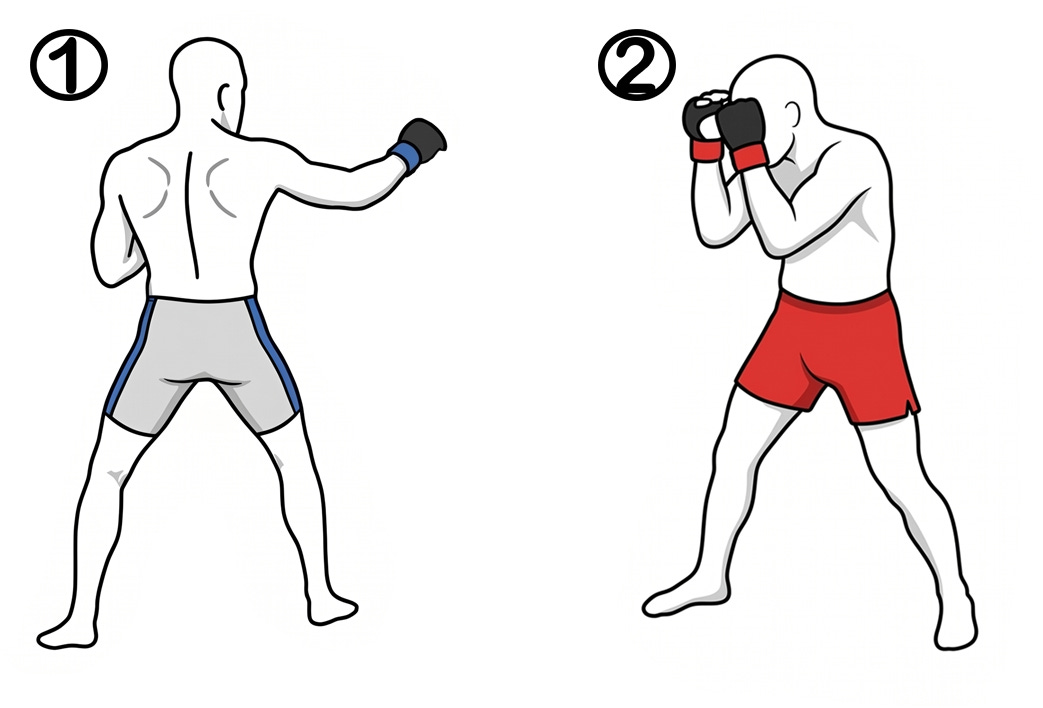
The first is Conor McGregor, who possesses one of the most threatening stances in MMA, and the second is a posture Della Maddalena frequently adopts. Standing in front of McGregor is like staring down the barrel of a loaded gun. His feet are set wide, his lead hand outstretched, obscuring the opponent’s vision or messing with their hand, and his rear hand is held cocked by his nipples, ready to fire hard at any moment. Whether opponents are consciously thinking about it or not, they see his knuckles pointing straight at them, his hips ready to propel, and remain sensitive to any slight twitch in his rear hip that might signal a punch or kick with knockout potential. The left hand and leg create a constant mental tax that makes every action taken by his opponent a little more hesitant, every reaction a little more frantic.
A fighter standing in front of the second fighter need not worry about an immediate powerful blow. He needs to form himself into some other shape before he’s ready to throw hard, and they can rest safe and wait for the telegraph to come. The height of his hands means that he needs to first lower his arm to spear his man with a powerful jab, or fold over his rear hip to align the rear fist and power a straight punch. His shoulders are locked square, which limits his ability to quickly rotate into kicks. His opponent can avoid the mental tax of reaction until they see his fist turn over or his hips rotate.
The final point I want to make about an effective high guard is that the standards earmuffs, with forearms held high and parallel, is narrowly useful as a block. Closing the forearms together and fully impeding a direct route to the chin opens up space around the sides, and vice versa. Keeping the hands high and tight also requires a lot of commitment and sacrifices threat, making it a poor catch all response to any attack.
Old-school boxing books are especially useful for adapting tactics to MMA, since boxers used to fight with much smaller gloves and rely more on positioning or outstretched hands to deny clean blows. Edwin Haislet’s Boxing was published in 1940 and remains one of the best manuals on pugilistic technique. He covers the standard attacks and defenses, but cautions against relying too much on tight blocking:
Blocking is the first line of defense. It means taking a blow on some part of the body which is less susceptible to injury. However, considerable resistance is necessary to block a hard blow which causes contusion of the tissue, nerves, and bone. Blocking, therefore, tends to weaken rather than conserve bodily forces. A well delivered blow, even if blocked, will disturb balance, prevent countering, and create openings for other blows.
Blocking may be used against all types of blows, either to face or body. It should be learned first and learned well. Later it should be used only when necessary.1
Haislet does not show any high blocks for defending straight punches to the head, instead recommending guarding (the use of outstretched arms to obtain inside position and dispel a blow’s force), parrying (sweeping the punching hand aside with the palm), or stopping (pinning the hand so a blow cannot be delivered.
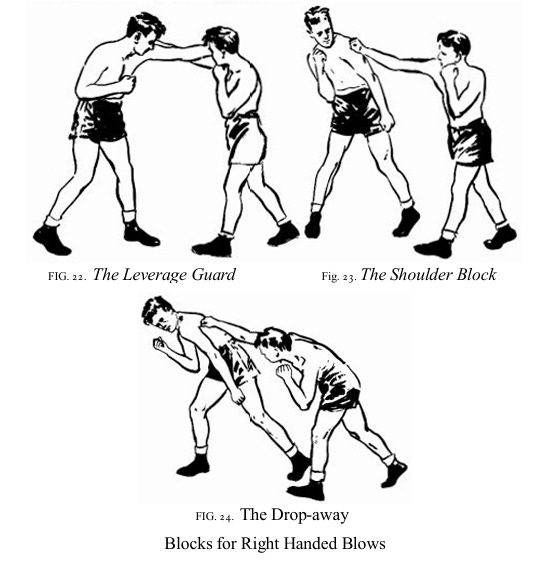
If a rear straight cannot be parried or deflected with the outstretched arm, it can instead be taken on the shoulder. Jack Dempsey echoes Haislet’s teaching in his book Championship Fighting, stating that straight right leads to the head are blocked by “the extended left hand” or the “hunched left shoulder”2.
The high forearm block is reserved for hooking blows around the side of the head:
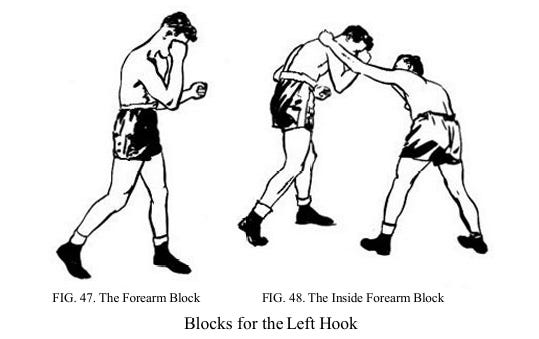
In MMA gloves, the coverage offered by the forearm block is even more porous, so it is often necessary to sacrifice defense to the body and raise the elbows even higher, so that the elbow and forearm form a protective shell around the ear.
The classic example is Quinton “Rampage” Jackson’s knockout of Wanderlei Silva in their third fight:
Rampage uses the block exactly as it’s designed. As Wanderlei comes forward with alternating hooks, Rampage raises his elbows in sequence and shifts his weight away from the blows. The elbow and forearm provide coverage around the ear, and the shifts of weight help to deflect the force of the punches while loading his hips for the counter hook that fells Silva.
Attempting to use the same block as one’s main response to straight punches not only leaves big coverage gaps, but it also entails a high commitment response to a low commitment stimulus. A powerful hooks takes some time to set up, or else often involves telegraph, leaving ample time to get the forearms high. But jabs and straights can be flicked out and shown with little weight transfer, forcing the defensive high-guard user to overcommit and expose themselves to other weapons.
This all goes back to the high guard as a system with multiple responses to a variety of inputs. The gold standard for a complete high guard defensive system in MMA is former Lightweight Champion, Rafael dos Anjos.
Dos Anjos primarily uses his hands on defense, but he doesn’t keep them plastered to his head. Instead, he raises them in anticipation or reaction, using subtler parries to deflect less committed blows, and adjusting the position of his hands and forearms as the opponent’s combination flows to work around the openings in his guard.
Where Della Maddalena Went Wrong
When Edwin Haislet was working out the most effective blocks, he didn’t have to contend with defending kicks at the same time. If he had, he would surely have had even harsher things to say about relying on high blocks as one’s primary method of defense.
The classic problem for an MMA fighter who relies on his hands to do most of his hitting is figuring out how to keep his lead leg safe. Throwing with power requires spending time with the lead foot weighted, exposing it as a target to kicks. But this is very solvable, and simply defending the leg kicks is not, in my estimation, the most grave problem posed by a boxing-based skillset. Anyone who has reached the top ten in a major division has likely developed tactics to mitigate their most obvious weakness, and punchers are increasingly learning to fold their leg back and let calf kicks drift underneath.
The most challenging aspect of leveraging a boxing skillset in elite MMA is navigating the distance. In a matchup between a skilled boxer who rarely kicks, and a skilled kicker, the kicker will have a range at which he can land his strikes and the boxer cannot. That range advantage extends farther back as well, ensuring that there is also a range at which the kicker’s feints are threatening and the boxer’s are not. It’s not uncommon to see a skilled boxer who relies on his jab as his primary means of engagement look utterly flummoxed when he meets someone who can simply stand outside of jabbing range and pick him off with longer weapons.
Della Maddalena’s dogged commitment to his high guard exacerbates these existing stylistic difficulties. The nature of that matchup means there is a range at which the high guard is entirely useless in MMA - serving zero defensive purpose (as it does not defend against kicks) and completely disarming him offensively. At that range, the natural telegraph involved in punching out of the guard turns from a stylistic downside to an unmitigable catastrophe.
